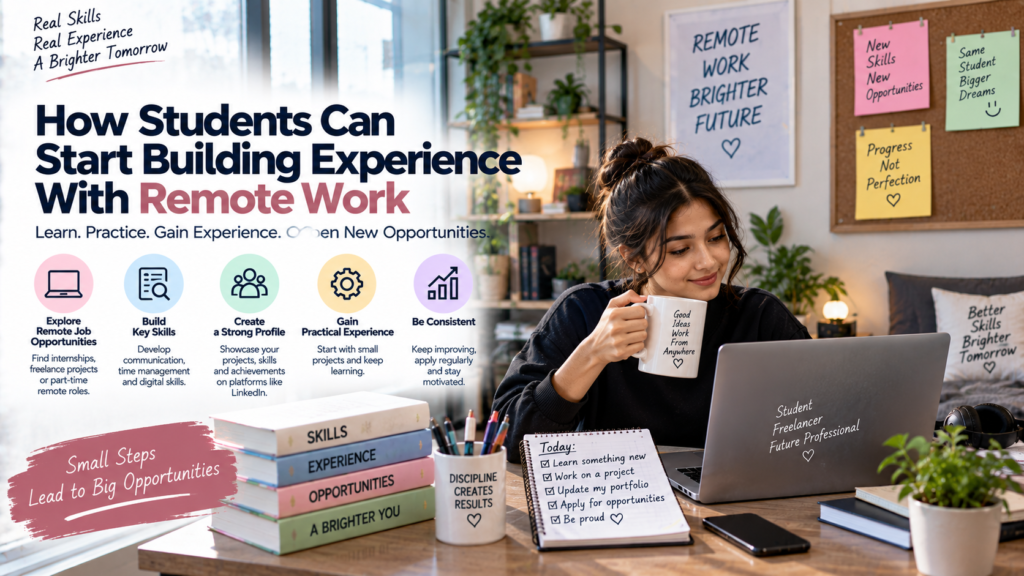

Learn how students can start building remote work experience through internships, freelance projects, volunteering, online courses, portfolios, and entry-level opportunities.
Remote work can give students an opportunity to develop professional skills while continuing their education. Students can gain experience through internships, freelance projects, part-time roles, volunteer work, online projects, and other flexible opportunities.
However, getting a first remote job can sometimes feel difficult because many employers prefer candidates who already have some experience. The good news is that students do not always need previous full-time employment to demonstrate their abilities.
Academic projects, personal projects, volunteer activities, freelance assignments, student organisations, and internships can all help students develop practical experience. By combining these activities with strong communication and digital skills, students can become better prepared for remote employment.
Why Remote Work Experience Matters for Students
Remote work experience can help students understand how professional teams operate in a digital environment. It can introduce them to online communication, deadlines, project management, collaboration tools, and professional expectations.
This experience can also make a student’s resume more competitive. Instead of listing only academic qualifications, students can demonstrate how they have applied their knowledge to practical tasks.
Remote experience may also help students discover which career areas they enjoy. A short project in marketing, web development, writing, customer support, design, or data analysis can provide useful insight before choosing a long-term career path.
Start by Identifying Your Existing Skills
Students often have more useful skills than they realise. The first step is to identify what you already know.
For example, students who are comfortable with computers may have skills in Microsoft Office, Google Workspace, programming, graphic design, or basic troubleshooting. Students with strong communication abilities may be suited to writing, tutoring, customer support, sales, or social media roles.
Academic subjects can also provide transferable skills. A student studying business may have research and presentation abilities, while a computer science student may have programming and database knowledge.
Write down your current skills and separate them into technical skills and soft skills. This will make it easier to identify suitable remote opportunities.
Build Strong Digital Skills
Most remote jobs require employees to use digital tools regularly. Students should therefore develop basic digital confidence before applying for remote positions.
Useful skills include creating and managing digital documents, using spreadsheets, sending professional emails, joining video meetings, sharing files, and collaborating through cloud-based platforms.
Students interested in technical careers can go further by learning programming, databases, web development, cybersecurity, data analysis, or other specialised technologies.
Strong digital skills can make it easier to adapt to different remote workplaces.
Look for Remote Internships
Internships are one of the most useful ways for students to gain professional experience.
A remote internship can allow students to work on real assignments under the guidance of experienced professionals. Depending on the organisation, students may assist with research, marketing, software development, administration, content creation, customer support, data work, or other activities.
When searching for internships, focus on opportunities related to your career interests. An internship does not need to be with a famous company to be valuable. The quality of the work, learning opportunities, supervision, and responsibilities are often more important.
Before accepting an internship, carefully verify the organisation and understand the responsibilities, duration, schedule, and compensation arrangements.
Take on Small Freelance Projects
Freelancing can help students gain practical experience without committing to a full-time role.
Students can offer skills such as writing, graphic design, video editing, web development, translation, social media management, data entry, tutoring, or presentation design.
Starting with small projects can make the process less overwhelming. Completing several manageable assignments can help students develop a work history and collect examples for their portfolios.
Students should also learn how to communicate with clients, clarify requirements, meet deadlines, and handle revisions professionally.
Create Personal Projects
Personal projects are particularly useful for students who have not yet found an internship or freelance client.
For example, an aspiring web developer can build a simple website. A marketing student can create a sample digital marketing campaign. A data student can analyse a public dataset and present the results.
The project should demonstrate skills relevant to the job you want.
Personal projects show initiative because they demonstrate that you can apply what you have learned without waiting for an employer to give you an assignment.
Use Academic Projects as Experience
College and university projects can sometimes become valuable portfolio material.
Instead of simply listing a project title on your resume, explain what you actually did. Mention the tools you used, the problem you addressed, your responsibilities, and the final result.
For example, a student who developed a website as part of a college project could describe the technologies used, the features created, and their specific contribution.
This approach helps employers understand the practical skills behind your academic work.
Volunteer for Remote Organisations
Volunteering can provide valuable experience while helping an organisation.
Students may be able to volunteer remotely in areas such as social media, content creation, research, administration, website support, event coordination, or community outreach.
Volunteer work can help students practise professional communication and responsibility. It can also provide portfolio examples and references when appropriate.
Choose opportunities carefully and make sure the organisation and role are legitimate.
Join Student Organisations
Student clubs and organisations can provide opportunities to develop workplace skills.
Students may take responsibility for social media, event planning, budgeting, communications, sponsorships, website updates, or team coordination.
These activities can demonstrate leadership, teamwork, organisation, and communication skills.
For remote career preparation, students can also volunteer to coordinate online meetings, manage digital documents, or organise virtual events.
Improve Your Communication Skills
Communication is especially important in remote work because colleagues often rely on email, chat, video calls, and shared documents.
Students should practise writing professional messages that are clear and concise. They should also learn how to ask questions, provide progress updates, explain problems, and respond appropriately to feedback.
Good communication does not mean using complicated language. It means making information easy for others to understand.
Learn How to Manage Deadlines
Remote employees are often expected to manage their responsibilities independently.
Students can practise this skill by creating weekly schedules and setting deadlines for assignments, projects, internships, and personal tasks.
Breaking a large project into smaller tasks can make deadlines easier to manage. Students should also learn to communicate early if they expect a delay.
Reliability is an important quality for remote workers, and consistently meeting commitments can help demonstrate it.
Learn Common Remote Collaboration Tools
Remote teams use different digital tools to communicate and manage work.
Students can become familiar with categories such as video conferencing, instant messaging, cloud storage, shared documents, project management, and version control.
The exact software used varies between employers. Therefore, students should focus not only on memorising individual applications but also on understanding how digital collaboration works.
For example, knowing how to share files, track tasks, comment on documents, and communicate project updates can transfer to many different workplace platforms.
Create a Professional Resume
A student resume does not need years of employment history.
Instead, it should highlight relevant education, skills, projects, internships, volunteer activities, certifications, achievements, and other experiences related to the target position.
When describing experience, focus on actions and outcomes. Explain what you contributed rather than simply listing that you participated.
Students should also customise their resume for each important application by highlighting the skills most relevant to the position.
Build an Online Portfolio
A portfolio can be particularly valuable for students seeking remote work.
Depending on your field, it could include websites, programming projects, writing samples, designs, presentations, research projects, marketing examples, spreadsheets, or other relevant work.
Keep the portfolio simple and organised. Each project should explain what you worked on, which tools or skills you used, and what you learned.
Even two or three strong projects can be more useful than a large collection of unfinished work.
Create a Professional Online Profile
A professional online presence can make it easier for employers and recruiters to understand your background.
Students can create a professional profile that includes their education, skills, projects, certifications, interests, and career goals.
Keep information accurate and professional. Make sure the skills listed on the profile match the abilities you can actually demonstrate.
Students should also regularly update their profiles as they gain new experience.
Start With Entry-Level Opportunities
Students should not feel that their first remote position needs to be their ideal long-term job.
Entry-level opportunities can provide an important starting point. Customer support, virtual assistance, content work, tutoring, research assistance, junior development, social media support, and administrative roles may offer useful experience depending on a student’s skills.
The goal of an early role is to develop transferable skills and learn how professional work operates.
As experience grows, students can apply for more specialised positions.
Network With Professionals
Networking can help students learn about career opportunities that may not be obvious from job advertisements.
Students can connect with professors, alumni, industry professionals, internship coordinators, career advisers, and people they meet through professional events.
Networking does not have to mean asking everyone for a job. Start by learning about different career paths, asking thoughtful questions, and building genuine professional relationships.
Over time, these connections may lead to useful advice, mentorship, projects, or employment opportunities.
Learn How to Work Independently
Remote employees often receive instructions and then complete tasks independently.
Students can prepare for this environment by practising how to research answers, troubleshoot simple problems, organise resources, and identify when they need assistance.
Independence does not mean refusing to ask questions. Good remote workers know when to investigate a problem themselves and when to communicate with a manager or teammate.
This balance can make students more effective in remote environments.
Be Careful About Remote Job Scams
Students looking for their first remote opportunity can sometimes be targeted by job scams.
Be cautious about offers that promise unusually high earnings for very simple work, require upfront payments, or request sensitive financial information before employment is properly verified.
Research the employer independently and check whether the position appears through an official company or trusted employment source.
Students should never feel pressured to accept a remote job immediately. Taking time to verify an opportunity can help reduce unnecessary risks.
Keep Track of Your Experience
Maintain a record of the projects and responsibilities you complete.
Write down the organisation or project name, your role, tools used, responsibilities, deadlines, and results. This information can later help you update your resume and prepare for interviews.
For example, instead of saying that you “worked on social media,” you may be able to explain that you created content, scheduled posts, researched topics, or helped analyse engagement.
Keeping records makes it easier to describe your experience accurately.
Ask for Feedback
Feedback can help students understand what they are doing well and where they need improvement.
After completing an internship, project, volunteer assignment, or freelance task, ask an appropriate supervisor or client for constructive feedback.
Use that feedback to improve your technical abilities, communication style, organisation, or work quality.
Being willing to learn from feedback is an important part of professional development.
Create a Simple Remote Work Plan
Students do not need to pursue every possible opportunity at the same time.
A simple plan can make the process easier:
- Choose one target career area.
- Identify the skills commonly required for that career.
- Improve one or two important skills.
- Create a practical project.
- Build or update your resume.
- Create a portfolio.
- Apply for internships or entry-level opportunities.
- Track applications and projects.
- Continue improving based on feedback.
Following a structured process can help students build experience gradually without becoming overwhelmed.
Sources
- https://www.careeronestop.org/
- https://www.naceweb.org/career-readiness/competencies/career-readiness-defined/
- https://www.bls.gov/ooh/
- https://www.oecd.org/en/topics/skills.html
- https://www.ilo.org/topics/skills-and-lifelong-learning
Conclusion
Students can start building remote work experience long before they graduate. Internships, freelance projects, personal projects, academic assignments, volunteering, student organisations, and entry-level opportunities can all provide useful experience when approached professionally.
The most important step is to start with what you already know and gradually develop skills that match your career goals. By building a portfolio, improving communication, learning digital tools, managing deadlines, and gaining practical experience, students can become better prepared for remote career opportunities.
Remote work experience is built over time. Students do not need a perfect resume before starting; they need a willingness to learn, practise, contribute, and improve.
FAQs
1. Can students get remote work without previous experience?
Yes. Students can begin with internships, freelance projects, volunteering, personal projects, campus activities, and entry-level positions to develop practical experience.
2. What remote jobs are suitable for students?
Depending on their skills, students can explore opportunities in writing, tutoring, customer support, virtual assistance, social media, design, data work, web development, research, and other entry-level areas.
3. How can students gain remote experience without getting a job?
Students can create personal projects, volunteer remotely, participate in student organisations, complete academic projects, contribute to open projects, or take on small freelance assignments.
4. Do remote internships help students?
Yes. Remote internships can provide exposure to professional workflows, digital communication, deadlines, teamwork, and real-world assignments.
5. Should students include college projects on their resumes?
Yes, when the projects are relevant to the position. Students should explain their responsibilities, tools, skills, and outcomes instead of only listing the project name.
6. Is a portfolio important for students?
A portfolio can be very useful, particularly for careers such as development, writing, design, marketing, data analysis, and other project-based fields.
7. What skills should students learn for remote work?
Useful skills include communication, time management, digital literacy, collaboration, problem-solving, self-discipline, and career-specific technical skills.
8. How can students find legitimate remote opportunities?
Use established employment resources, company career pages, educational career services, and professional networks. Always research an employer before sharing sensitive information or accepting an offer.
9. Can volunteering count as work experience?
Relevant volunteer work can demonstrate practical skills, responsibility, teamwork, and initiative. Students should describe the actual tasks and contributions they made.
10. How can students prepare for remote job interviews?
Students should research the company, understand the job description, practise common interview questions, prepare examples of projects and skills, and test their internet connection and equipment before the interview.