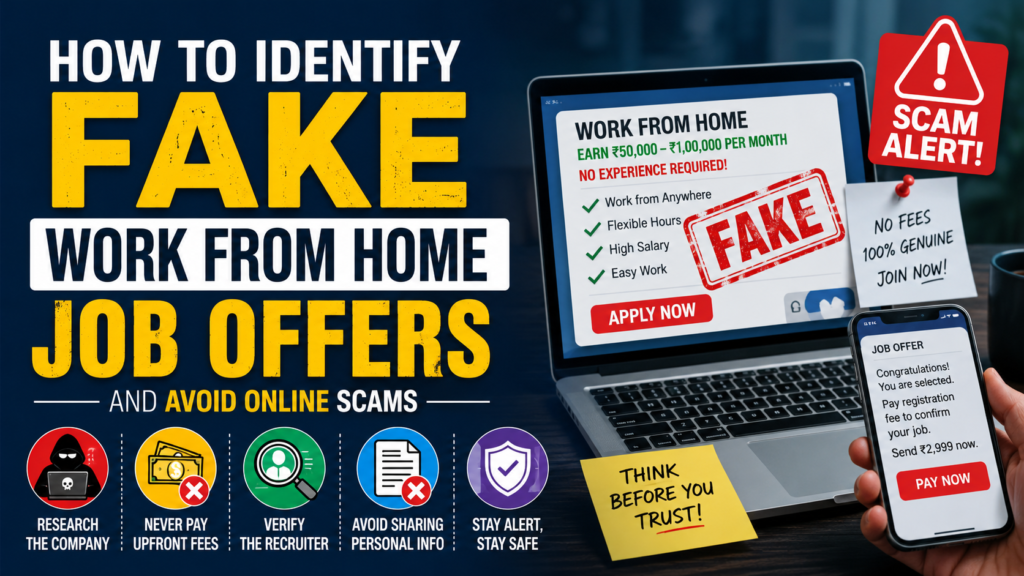

Learn how to identify fake work from home job offers, recognize online job scams, verify employers, protect personal information, and find legitimate remote jobs safely.
Work-from-home jobs have become increasingly popular because they allow people to earn money without travelling to an office every day. Remote opportunities are available in fields such as customer support, content writing, software development, digital marketing, data analysis, virtual assistance, and online education. These jobs can offer flexibility and help people balance their professional and personal responsibilities.
However, the growing demand for remote employment has also created opportunities for scammers. Fraudsters often advertise fake work-from-home jobs to attract students, fresh graduates, unemployed individuals, and people looking for additional income. They may promise high salaries, flexible working hours, and immediate selection without requiring interviews or checking qualifications.
Some fake employers ask applicants to pay registration fees, purchase training materials, complete unpaid tasks, or share sensitive personal information. Others use messaging applications and social media to build trust before demanding money or directing applicants to fraudulent websites.
Knowing how to identify fake work from home job offers is essential for protecting your money, personal information, and time. A professional-looking advertisement does not necessarily mean that an employer is genuine, and a high salary does not guarantee that an opportunity is legitimate.
This article explains 12 warning signs of remote job scams, practical ways to verify employers, common fraud techniques, and the steps you should take if you encounter a suspicious job offer.
1. Be Careful of Jobs Promising Extremely High Salaries for Simple Tasks
One of the most common warning signs is an offer that promises unusually high earnings for very little work.
For example, a message might claim that you can earn thousands of rupees every day by liking social media posts, copying simple information, watching videos, or completing basic online forms for just a few minutes.
Although legitimate employers may offer competitive salaries for certain remote positions, earnings usually depend on the role, experience, responsibilities, working hours, and required skills.
Scammers use unrealistic income promises to attract applicants quickly, particularly people who urgently need employment.
How to Recognize This Warning Sign
- The salary seems far higher than typical compensation for similar work.
- The advertisement promises guaranteed income without explaining the responsibilities.
- You are told that no skills, experience, or training are needed for a high-paying position.
- The employer avoids explaining how the company earns money.
- The offer emphasizes earnings rather than the actual job.
What You Should Do
Research salary ranges for similar positions and compare the advertised responsibilities with other genuine job listings. Ask for a detailed job description, working hours, payment structure, and information about the employer.
Do not trust a job offer simply because the promised salary sounds attractive.
2. Never Pay Registration Fees to Secure a Job Without Proper Verification
Another major warning sign is a request to pay money before you can begin working.
Fake recruiters may ask for registration charges, application processing fees, security deposits, interview fees, identity card charges, or mandatory payments for receiving a job offer.
They may claim that the payment is refundable or that it is required to confirm your selection. After receiving the money, the scammer may stop responding or demand additional payments.
Legitimate hiring processes vary, but applicants should be extremely cautious when a supposed employer requires personal payments to guarantee employment.
Common Payment Requests
- Job registration or application fees.
- Security deposits before joining.
- Payments to release an appointment letter.
- Mandatory purchases from a recruiter.
- Charges for access to supposed guaranteed job opportunities.
How to Protect Yourself
Ask for the company’s official hiring policy and verify the opportunity through its independently located official website or recruitment team.
Do not send money to a personal bank account, digital wallet, or UPI ID merely because a recruiter claims the payment is necessary.
Remember that a receipt, payment screenshot, or official-looking document does not prove that an employer is genuine.
3. Verify the Company Before Applying
Scammers frequently impersonate real companies or create fake businesses that appear professional. They may copy logos, company descriptions, employee photographs, and branding from legitimate organizations.
A fake recruitment message can therefore look convincing, even when the company name belongs to a real business.
Before applying, independently verify the employer.
Steps to Check a Company
Visit the official website: Find the website independently rather than relying entirely on a link provided by the recruiter.
Check the careers page: Search for the advertised position on the company’s official recruitment page.
Verify contact information: Compare the recruiter’s email address and contact details with those published by the company.
Research the business: Look for credible information about its products, services, operations, and history.
Check its legal identity when relevant: In India, you may be able to verify a company’s registration details through the Ministry of Corporate Affairs website.
Contact the company directly: If you are unsure, contact its official HR department using independently verified contact information.
Be aware that a website or company registration alone does not prove that a particular job offer is genuine. Scammers can impersonate legitimate companies and misuse real business details.
4. Watch Out for Recruiters Who Avoid Proper Interviews
Most legitimate employers use some form of assessment or screening to determine whether an applicant is suitable for a position. Depending on the role, this might include a phone call, video interview, technical test, portfolio review, or discussion with a hiring manager.
A recruiter who offers a high-paying job immediately without asking about your skills or experience may be a cause for concern.
Some legitimate jobs have simple hiring processes, so the absence of an interview is not conclusive evidence of fraud. However, it becomes more suspicious when combined with unrealistic salary promises, urgent demands, or requests for money.
Warning Signs During Recruitment
- You are selected without any meaningful discussion about the role.
- The recruiter refuses to explain the job responsibilities.
- The supposed employer does not identify the hiring manager.
- You receive an appointment letter before any reasonable screening.
- The recruiter pressures you to accept immediately.
Ask questions about the role, reporting manager, training, salary, working schedule, and employment agreement. A genuine hiring process should allow you to understand the position before accepting it.
5. Be Suspicious of WhatsApp and Telegram Job Messages
Messaging applications are commonly used for communication, but scammers also use them to distribute fake employment offers.
You might receive an unexpected message claiming that a recruiter found your number online and can offer you a remote job immediately. Some messages advertise simple tasks with fixed daily earnings.
In task-based scams, victims may initially receive small payments to create trust. Later, they may be asked to deposit money to unlock additional tasks, increase earnings, or withdraw a supposed balance.
After the victim sends a larger amount, the scammer may demand further payments or disappear.
Protect Yourself From Messaging-App Job Scams
- Verify the recruiter through the company’s official channels.
- Do not trust a job offer solely because it appears in a professional-looking group.
- Avoid sending money to unlock tasks or withdraw earnings.
- Never share OTPs, banking passwords, or UPI PINs.
- Do not install unknown applications at a recruiter’s request.
- Be cautious of screenshots showing other people supposedly earning large amounts.
A message from a familiar-looking account is not proof of legitimacy because accounts and identities can be impersonated.
6. Check the Recruiter’s Email Address and Website
Email addresses and website domains can provide useful clues when evaluating job offers.
A genuine recruiter working for a company may communicate through an official corporate email address. A suspicious recruiter might instead use a free email account, a misspelled domain, or a website created to resemble a well-known business.
However, smaller legitimate businesses may also use common email services, so the email address alone should not determine your decision.
What to Look For
Misspelled domains: A fraudulent website may use a web address that differs slightly from the official company domain.
Unrelated email addresses: The recruiter’s email address may have no verifiable connection to the employer.
Recently created websites: A new domain is not automatically fraudulent, but it deserves additional scrutiny when other warning signs exist.
Missing company details: A website that lacks credible contact information, clear business details, or meaningful information about its services may be suspicious.
Copied content: Fraudulent sites sometimes copy text and branding from genuine companies.
Use the official company website to verify contact details and job listings. Avoid clicking unexpected links or entering personal information on websites you have not independently verified.
7. Never Share Sensitive Personal or Banking Information Too Early
Job applications may legitimately require certain personal details. However, scammers may use fake recruitment processes to collect information for identity theft or financial fraud.
For example, they might request a copy of your identity document, bank details, tax information, or photographs before confirming that the employer is genuine.
Some information may be necessary after a legitimate offer, particularly for payroll and legally required employment records. The timing, purpose, and security of the request matter.
Information You Should Never Share With an Unverified Recruiter
- OTPs sent to your phone or email.
- UPI PINs, ATM PINs, or banking passwords.
- Internet banking login credentials.
- Credit or debit card security codes.
- Passwords for your email or other accounts.
- Unnecessary copies of sensitive identity documents.
Never share an OTP or banking PIN to receive a salary, verify a job application, or release an employment payment.
If a genuine employer requires identity or payroll documentation, confirm the employer’s identity first and use a secure, appropriate submission process.
8. Avoid Fake Data Entry and Captcha Jobs That Demand Penalties
Data entry, form filling, and captcha-related work are frequently used in misleading job advertisements because they sound simple and accessible to beginners.
Some advertisements promise large payments for completing thousands of forms or typing short entries. After applicants begin working, the supposed employer may claim that their accuracy rate is too low and demand a penalty or legal settlement.
Other schemes require applicants to sign agreements containing unrealistic financial penalties for incomplete work.
Warning Signs
- The company promises unusually high income for repetitive work.
- You must pay to receive assignments.
- The contract includes unclear or excessive penalty clauses.
- The recruiter refuses to explain how accuracy is measured.
- You must pay money to access your salary.
- The employer threatens legal action immediately after you question the terms.
Before accepting data entry work, review the written agreement, payment conditions, deadlines, and any deductions.
Do not assume that every data entry job is fraudulent. Instead, verify the company, the work requirements, and the payment arrangement before starting.
9. Research Reviews and Complaints Carefully
Online research can help identify suspicious employers, especially when multiple people report similar experiences.
Search for the company name along with phrases such as “job scam,” “fraud complaint,” “registration fee,” or “salary not paid.”
Look for independent reviews, credible news reports, and discussions from people who describe specific experiences.
However, reviews must be interpreted carefully. Fake positive reviews can be purchased, competitors may post misleading complaints, and legitimate businesses can receive negative feedback.
How to Evaluate Online Reviews
- Look for repeated complaints describing the same payment scheme.
- Check whether reviewers provide specific, verifiable details.
- Compare information across multiple independent sources.
- Distinguish complaints about poor management from evidence of fraud.
- Check whether the company has responded to credible concerns.
Do not rely only on testimonials posted on the recruiter’s own website or screenshots shared in a messaging group.
If you find repeated reports of applicants being asked to pay money and then losing contact with the recruiter, treat the offer with particular caution.
10. Understand the Difference Between Genuine Remote Jobs and Scams
Remote work is a legitimate employment arrangement used by companies across many industries. The goal is not to avoid every online job opportunity, but to distinguish credible employers from fraudulent offers.
Genuine remote positions generally provide clearer information about responsibilities, working hours, compensation, required qualifications, and the hiring process.
Scammers, by contrast, may emphasize urgency, easy money, guaranteed selection, and payment requests.
Examples of Legitimate Remote Job Categories
Content writing: Creating articles, website content, product descriptions, and other written materials.
Customer support: Responding to customer questions through approved communication channels.
Software development: Building, maintaining, and testing applications or websites.
Digital marketing: Supporting search engine optimization, social media, advertising, and content strategy.
Virtual assistance: Helping with scheduling, research, documentation, and administrative work.
Data analysis: Working with datasets, spreadsheets, reporting tools, and databases.
These categories can include genuine employment opportunities, but the job title itself does not guarantee legitimacy. Verify each employer and specific offer independently.
11. Use Trusted Job Portals and Safe Application Practices
Using established recruitment platforms can make it easier to research employers and compare job descriptions. However, even recognized job portals may contain misleading listings or impersonation attempts.
Treat a listing as the beginning of your verification process rather than proof that a job is genuine.
Safer Job Search Practices
- Search for openings on official company careers pages.
- Use reputable job platforms with reporting and verification features.
- Read the complete job description before applying.
- Check the company and recruiter independently.
- Keep records of job advertisements and recruitment messages.
- Avoid payments for guaranteed placement or job selection.
- Use a separate, professional email address for job applications.
- Keep your resume focused on information relevant to the position.
- Review employment agreements before signing.
- Confirm the salary, payment schedule, work location, and reporting structure in writing.
Never rely solely on a platform’s verification badge or the number of applications a listing has received.
12. What to Do If You Have Already Encountered a Job Scam
If you suspect that a remote job offer is fraudulent, stop communicating with the recruiter until you have verified the opportunity.
If you have shared personal information or sent money, take action promptly.
If You Have Paid Money
Contact your bank or payment provider immediately. Explain that you may have been the victim of fraud and ask whether the transaction can be stopped, disputed, or traced.
In India, you can report suspected cyber financial fraud through the National Cyber Crime Reporting Portal or call the national cybercrime helpline at 1930. Report the incident as soon as possible.
Official reporting resources:
- National Cyber Crime Reporting Portal: https://cybercrime.gov.in/
- Ministry of Home Affairs: https://www.mha.gov.in/
Reporting does not guarantee recovery of money, but prompt action may improve the chance of taking timely measures.
If You Shared Passwords or OTPs
Change affected passwords immediately using a trusted device. If you shared banking credentials, contact your bank and follow its instructions to secure your accounts.
Never provide additional OTPs or PINs to someone claiming to be a recovery agent.
If You Installed an Unknown Application
Disconnect from suspicious remote-access sessions, review installed applications, and remove software you do not recognize after assessing its purpose. Contact your bank promptly if the application may have exposed financial accounts.
If you suspect that your device has been compromised, use a trusted device to change important passwords and consider professional technical assistance.
If You Shared Identity Documents
Monitor your accounts for suspicious activity, report suspected misuse to the relevant authority, and follow the appropriate identity-protection procedures for your country.
Keep copies of messages, transaction receipts, phone numbers, email addresses, and website links as evidence for reporting.
Sources
https://cybercrime.gov.in/
https://consumer.ftc.gov/articles/job-scams
Conclusion
Knowing how to identify fake work from home job offers is essential in today’s digital employment environment. Remote jobs provide genuine opportunities for people seeking flexible work, but scammers can exploit that demand through unrealistic salary promises, fake recruitment messages, advance-fee demands, misleading contracts, and requests for sensitive information.
Before accepting an online job, verify the employer through independently located official channels, examine the job description, research the recruiter, and understand the payment terms. Be particularly cautious if someone demands money to secure employment, pressures you to act immediately, or requests OTPs and banking credentials.
You can reduce your risk by using reputable job platforms, reviewing employment agreements, protecting your personal information, and keeping records of suspicious interactions. If you believe you have been scammed, contact your bank or payment provider promptly and report the incident through the appropriate official channels.
Remember: A genuine job should offer clear responsibilities and verifiable employment details. Taking time to check an opportunity before sharing information or sending money can help protect your finances and personal security.
FAQs
1. How can I identify a fake work-from-home job offer?
Look for warning signs such as unrealistic salary promises, advance-fee requests, immediate selection without a reasonable hiring process, vague responsibilities, suspicious email addresses, and demands for sensitive information. Verify the company independently before proceeding.
2. Are work-from-home jobs that ask for registration fees genuine?
A request to pay a fee to guarantee employment is a serious warning sign. Do not send money without independently verifying the employer and understanding the purpose of the payment. Be especially cautious of refundable-deposit promises and payments required to release a salary.
3. How can I check whether an online company is genuine?
Visit the company’s official website independently, search its careers page, verify recruiter contact details, research its business history, and look for credible independent information. Remember that scammers can impersonate real companies, so confirm the specific job offer directly with the employer.
4. What should I do if I lose money in a work-from-home job scam in India?
Contact your bank or payment provider immediately and report suspected cyber financial fraud through https://cybercrime.gov.in/ or by calling 1930. Preserve transaction details and communication records. Avoid anyone who demands additional payment to recover your money.
5. Where can I find legitimate work-from-home jobs?
Look for remote vacancies on official company careers pages and established job portals. Search for roles that match your qualifications, such as content writing, customer support, software development, digital marketing, virtual assistance, and data analysis. Verify every specific employer and offer before accepting a position.