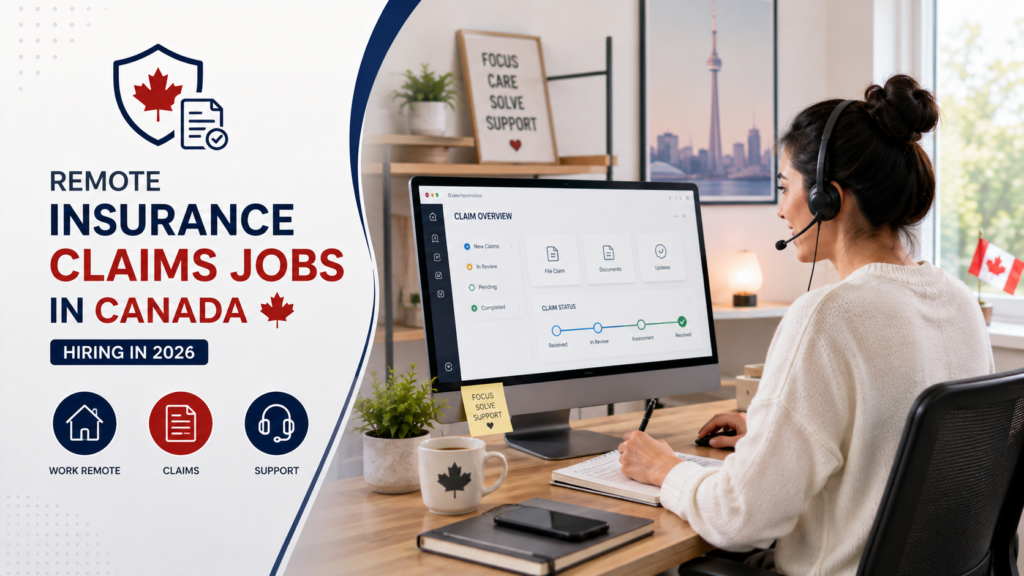

Explore Canada remote insurance claims jobs hiring in 2026. Learn about claims adjuster, claims examiner, claims analyst, and claims processing roles, skills, qualifications, salaries, and remote work opportunities.
Remote insurance claims jobs are becoming an attractive career option for professionals who want to work in Canada’s insurance industry while having greater flexibility over where they work. Claims-related positions can involve reviewing documentation, investigating losses, communicating with policyholders, assessing coverage, processing claims, and supporting settlement decisions.
In 2026, Canadian job listings include remote and hybrid opportunities across areas such as property claims, auto insurance, bodily injury, medical claims, claims examination, claims administration, and claims operations.
Remote insurance claims work can be suitable for people with insurance experience as well as professionals developing administrative, customer service, analytical, or financial skills. However, many claims adjuster positions require industry experience, provincial licensing, or specialised knowledge.
What Are Remote Insurance Claims Jobs?
Remote insurance claims jobs involve handling some or most claims-related responsibilities outside a traditional office.
Depending on the position, employees may use digital systems to:
- Review insurance claims.
- Examine policy information.
- Contact policyholders.
- Collect documentation.
- Assess damages or losses.
- Review repair estimates.
- Investigate claim circumstances.
- Communicate with brokers and service providers.
- Prepare claims reports.
- Process settlements.
- Maintain digital claim records.
The exact responsibilities depend on the type of insurance and the seniority of the position.
Types of Remote Insurance Claims Jobs in Canada
There are several career paths within insurance claims.
1. Claims Adjuster
Claims adjusters investigate and evaluate insurance claims.
Their responsibilities may include:
- Reviewing claim details.
- Assessing coverage.
- Gathering evidence.
- Communicating with customers.
- Evaluating damages.
- Negotiating settlements.
- Documenting claim decisions.
Remote and hybrid claims adjuster opportunities are available in different areas of the Canadian insurance industry, including senior positions.
2. Claims Examiner
Claims examiners review claims to determine whether they meet policy requirements and internal procedures.
They may:
- Review claim documentation.
- Evaluate policy coverage.
- Assess claim reserves.
- Verify information.
- Review settlement recommendations.
- Ensure claims follow company procedures.
Some remote claims examiner positions offer salaries in the range of approximately $60,000–$90,000, depending on the employer and candidate’s experience.
3. Claims Analyst
Claims analysts use information and documentation to support claims operations and decision-making.
Their work may involve:
- Reviewing claims data.
- Identifying trends.
- Checking documentation.
- Preparing reports.
- Supporting claims teams.
- Monitoring claim performance.
Remote claims analyst positions can be found among Canadian work-from-home insurance opportunities.
4. Claims Administrator
Claims administrators provide administrative support throughout the claims process.
Typical tasks can include:
- Managing claim files.
- Updating records.
- Responding to emails.
- Organising documentation.
- Communicating with customers.
- Supporting adjusters.
Some employers offer work-from-home claims administration roles, depending on location and job requirements.
5. Claims Processing Specialist
Claims processing specialists focus on the administrative and procedural side of claims.
They may verify information, process documentation, update systems, and ensure claims move through the appropriate stages.
These positions can be suitable for candidates who have strong organisational and administrative skills.
6. Insurance Claims Adjudicator
Claims adjudicators review claims and determine whether they meet policy requirements.
They may evaluate:
- Policy terms.
- Claim documentation.
- Repair estimates.
- Medical information.
- Eligibility.
- Settlement requirements.
Claims adjudicator opportunities can cover areas such as accident and health insurance, mechanical breakdown insurance, and other specialised insurance products.
What Does a Remote Claims Adjuster Do?
A remote claims adjuster can have responsibilities similar to an office-based adjuster, although much of the communication and documentation may be completed digitally.
Daily duties can include:
- Reviewing new claims.
- Contacting policyholders.
- Investigating incidents.
- Reviewing policy coverage.
- Gathering supporting documentation.
- Assessing financial losses.
- Communicating with contractors or other professionals.
- Negotiating settlements.
- Updating claims management systems.
- Preparing reports.
Some positions are completely remote, while others use a hybrid arrangement or require field visits.
Remote vs. Hybrid Insurance Claims Jobs
It is important to read job descriptions carefully because “remote” does not always mean that an employee can work from anywhere.
Some Canadian positions combine home and office work. Other positions may be advertised specifically as remote but can still include provincial location restrictions, occasional travel, or other requirements.
Before applying, check:
- Whether the job is fully remote.
- Whether occasional office attendance is required.
- Whether travel is required.
- Which province you must live in.
- Whether a licence is required.
- Whether training is conducted remotely.
Qualifications for Remote Insurance Claims Jobs
Requirements vary considerably.
Education
Some employers may prefer candidates with:
- College diplomas.
- University degrees.
- Insurance-related education.
- Business education.
- Finance-related education.
However, education requirements depend on the specific position.
Insurance Experience
Experienced claims positions often require previous insurance or claims experience.
Senior claims positions may require several years of relevant experience, particularly for specialised areas such as property, bodily injury, professional liability, or complex commercial claims.
Industry Designations
Insurance-related professional education can strengthen a candidate’s profile.
Depending on the position, employers may value designations or progress toward professional insurance qualifications.
Licensing
Licensing requirements can vary according to the province and type of claims work.
Candidates should carefully review the licensing requirements mentioned in each job advertisement before applying.
Skills Needed for Remote Insurance Claims Jobs
Successful claims professionals need a combination of technical and interpersonal skills.
Communication Skills
Claims professionals regularly communicate with:
- Policyholders.
- Brokers.
- Insurance companies.
- Contractors.
- Repair professionals.
- Legal professionals.
- Internal teams.
Clear written and verbal communication is therefore important.
Analytical Skills
Claims work requires careful evaluation of information.
Professionals may need to compare:
- Policy wording.
- Claim details.
- Supporting documents.
- Estimates.
- Reports.
- Other evidence.
Strong analytical skills can help employees make accurate decisions.
Attention to Detail
A small documentation error can affect a claim.
Claims professionals need to pay attention to:
- Dates.
- Policy details.
- Claim amounts.
- Supporting documents.
- Customer information.
- Settlement details.
Organisation
Remote claims professionals may manage multiple files simultaneously.
Good organisation helps ensure that:
- Deadlines are met.
- Documentation is complete.
- Follow-ups are completed.
- Claim records remain accurate.
Customer Service
Insurance claims can be stressful for policyholders.
Professionals should be able to explain processes clearly and communicate respectfully, even when customers are frustrated.
Technology Skills
Remote claims employees usually rely heavily on digital tools.
Useful technical abilities can include:
- Claims management systems.
- Customer relationship management systems.
- Microsoft Office.
- Spreadsheet software.
- Email.
- Video conferencing.
- Digital document management.
- Online communication platforms.
Technology requirements vary between employers.
Salary Expectations for Remote Insurance Claims Jobs
Salary varies based on experience, location, insurance specialty, licensing, employer, and job responsibilities.
Current job advertisements provide examples of this variation.
For example:
- A senior claims adjuster position may offer approximately $72,000–$108,000 per year.
- A senior Ontario remote claims adjuster position may offer approximately $85,000–$115,000 per year.
- A remote Claims Examiner position may offer approximately $60,000–$90,000 per year.
- A senior professional liability claims examiner position may offer approximately $111,100–$172,465 per year.
These are examples from job advertisements rather than guaranteed salaries for all Canadian remote claims positions.
Entry-Level Remote Insurance Claims Jobs
People without extensive claims experience may find it more difficult to enter directly into senior adjuster positions.
Instead, beginners can look for roles such as:
- Claims assistant.
- Claims administrator.
- Claims processing clerk.
- Customer service representative.
- Insurance service representative.
- Claims support specialist.
- Junior claims analyst.
These positions can help candidates develop knowledge of insurance policies, documentation, customer service, and claims procedures.
Remote Insurance Claims Jobs for Experienced Professionals
Experienced professionals may qualify for positions such as:
- Senior Claims Adjuster.
- Claims Examiner.
- Claims Consultant.
- Claims Specialist.
- Claims Manager.
- Bodily Injury Adjuster.
- Property Claims Adjuster.
- Auto Claims Adjuster.
- Professional Liability Claims Examiner.
Specialised claims experience can be particularly valuable for senior positions.
Property Claims Jobs
Property claims professionals deal with losses involving homes, buildings, commercial properties, and other insured assets.
Responsibilities can include:
- Reviewing property damage.
- Evaluating repair estimates.
- Investigating losses.
- Communicating with policyholders.
- Working with contractors.
- Determining claim values.
- Processing settlements.
Some property claims positions are remote or hybrid, although field-related positions may require travel.
Auto Insurance Claims Jobs
Auto claims professionals handle insurance claims involving vehicles and related losses.
Their work can include:
- Reviewing accident information.
- Assessing vehicle damage.
- Reviewing repair estimates.
- Communicating with customers.
- Evaluating coverage.
- Coordinating repairs.
- Processing settlements.
Remote and hybrid auto claims opportunities can be available depending on the employer and province.
Bodily Injury Claims Jobs
Bodily injury claims can involve more complex investigations and negotiations.
Professionals may review:
- Accident circumstances.
- Medical documentation.
- Liability.
- Policy coverage.
- Settlement information.
Because these cases can be complex, employers may prefer experienced claims professionals.
Medical Claims Jobs
Medical claims positions can involve reviewing healthcare-related claims and supporting documentation.
Potential roles include:
- Medical claims specialist.
- Claims adjudicator.
- Medical claims processor.
- Claims examiner.
- Medical claims billing specialist.
These roles may require knowledge of healthcare documentation, insurance policies, claims procedures, and privacy requirements.
Insurance Claims Jobs by Province
Remote opportunities can be advertised across Canada, but some employers restrict positions to particular provinces.
Current opportunities may be associated with:
- Ontario.
- Alberta.
- Quebec.
- British Columbia.
- Manitoba.
- Saskatchewan.
- Other Canadian locations.
Always check the location requirement before submitting an application.
Benefits of Working Remotely in Insurance Claims
Remote claims work can offer several potential advantages.
Flexible Work Environment
Working from home can reduce the need for daily commuting.
Better Work-Life Organisation
Remote work may provide greater flexibility for managing personal responsibilities.
Access to Wider Job Opportunities
Remote positions can allow candidates to consider employers outside their immediate city.
Digital Work Experience
Claims professionals working remotely can develop strong experience with digital communication and document-management systems.
Career Growth
Insurance claims can offer pathways toward specialist, senior, supervisory, and management positions.
Challenges of Remote Claims Work
Remote employment also comes with challenges.
High Attention to Detail
Claims decisions often involve large amounts of documentation.
Customer Pressure
Policyholders may contact claims teams during stressful situations.
Performance Expectations
Remote employees may still have strict productivity and service targets.
Licensing Requirements
Some claims positions require specific provincial licences.
Limited Entry-Level Fully Remote Roles
Many fully remote claims positions are aimed at experienced professionals, while beginners may encounter more hybrid or office-based opportunities.
How to Find Remote Insurance Claims Jobs in Canada
Candidates can search using job titles such as:
- Remote Claims Adjuster.
- Insurance Claims Adjuster.
- Claims Examiner.
- Claims Analyst.
- Claims Specialist.
- Claims Administrator.
- Claims Adjudicator.
- Claims Processing Specialist.
- Remote Insurance Advisor.
- Claims Consultant.
Using several related job titles can help candidates find a wider range of opportunities.
How to Improve Your Resume
A strong resume should highlight relevant experience rather than simply stating that you want a remote job.
Include skills such as:
- Claims investigation.
- Policy interpretation.
- Customer service.
- Documentation.
- Negotiation.
- Claims processing.
- Risk assessment.
- Report writing.
- Data analysis.
- Insurance software.
Use measurable achievements when possible.
For example, instead of writing:
You could describe the type and scale of claims you handled, the systems you used, and the results you achieved.
How to Prepare for a Claims Job Interview
Employers may ask questions about both technical knowledge and customer service.
Prepare to discuss:
- How you investigate a claim.
- How you handle difficult customers.
- How you prioritise multiple claims.
- How you evaluate documentation.
- How you handle confidential information.
- How you manage deadlines.
- How you work independently.
- How you communicate remotely.
You should also be ready to explain your knowledge of the relevant insurance products.
Remote Work Skills Employers May Look For
In addition to insurance expertise, employers may value:
- Self-management.
- Time management.
- Digital communication.
- Independent problem-solving.
- Reliability.
- Organisation.
- Adaptability.
- Professional communication.
Remote employees often need to manage their workload without constant direct supervision.
How Beginners Can Enter the Insurance Industry
If you are new to insurance, consider building experience through related roles.
Possible starting points include:
- Customer service.
- Insurance administration.
- Claims support.
- Data entry.
- Policy administration.
- Call centre insurance services.
- Junior claims processing.
Learning basic insurance terminology can also make interviews easier.
Common Insurance Claims Terms to Understand
Candidates should become familiar with terms such as:
- Policy.
- Premium.
- Deductible.
- Coverage.
- Claim.
- Adjuster.
- Liability.
- Settlement.
- Reserve.
- Underwriting.
- Subrogation.
- Claimant.
- Policyholder.
Understanding these terms can help candidates communicate more confidently during interviews.
How to Avoid Fake Remote Insurance Jobs
Job seekers should be cautious when searching for work-from-home opportunities.
Be careful if an employer:
- Requests money before hiring.
- Promises unusually high pay for little work.
- Asks for sensitive information too early.
- Uses an unofficial email address.
- Avoids a proper interview.
- Sends unexpected payment requests.
- Asks you to purchase equipment through an unusual process.
Research the employer and verify the job through a legitimate employment source before sharing sensitive information.
What Employers Look for in Claims Professionals
Insurance companies generally need employees who can balance accuracy, customer service, analysis, and policy requirements.
Strong candidates can demonstrate:
- Insurance knowledge.
- Professional communication.
- Analytical thinking.
- Attention to detail.
- Claims experience.
- Organisation.
- Negotiation skills.
- Ethical decision-making.
- Ability to work independently.
Career Growth in Insurance Claims
Insurance claims can provide several potential career paths.
An employee might progress from:
Claims Assistant → Claims Representative → Claims Adjuster → Senior Claims Adjuster → Claims Specialist → Claims Manager
The exact progression depends on education, experience, licensing, employer opportunities, and professional development.
Is Remote Insurance Claims Work a Good Career Choice?
Remote insurance claims work may be a good option for people who enjoy analytical tasks, customer communication, problem-solving, documentation, and structured processes.
It can be particularly attractive to professionals who already have insurance experience and want more flexibility.
However, candidates should understand that claims work can involve deadlines, difficult conversations, detailed documentation, and regulatory requirements.
Sources
- Recognised Canadian employment resources.
- Canadian insurance industry resources.
- Job market listings.
- Insurance education resources.
- Professional career resources.
Source Links
- https://www.jobbank.gc.ca/
- https://www.insuranceinstitute.ca/
- https://ca.indeed.com/
- https://ca.linkedin.com/jobs/
Conclusion
Canada’s remote insurance claims job market in 2026 includes opportunities across claims adjusting, claims examination, claims analysis, claims administration, claims processing, and specialised insurance areas. Employers may recruit for both remote and hybrid roles, although many experienced positions have specific requirements related to claims experience, location, licensing, or insurance knowledge.
Candidates who want to enter this field should focus on building strong communication, analytical, organisational, customer service, and insurance-related skills. Experienced professionals can explore specialised areas such as property, auto, bodily injury, medical, and professional liability claims.
Before applying, carefully check whether a position is fully remote or hybrid, whether provincial licensing is required, and whether the employer expects previous claims experience. With the right qualifications and a targeted resume, remote insurance claims work can provide a practical pathway into Canada’s insurance industry.
Frequently Asked Questions (FAQs)
1. Are there remote insurance claims jobs in Canada in 2026?
Yes. Canadian employers offer remote and hybrid opportunities in claims adjusting, claims examination, claims analysis, claims administration, and other insurance-related areas.
2. Can beginners get remote insurance claims jobs?
Beginners may find entry-level opportunities in claims administration, customer service, claims processing, and support roles. Fully remote adjuster positions often have more experience requirements.
3. Do insurance claims adjusters need a licence in Canada?
Licensing requirements can vary by province and the type of claims work. Candidates should check the specific requirements associated with the position and province.
4. How much can remote claims professionals earn?
Salary varies widely. Some claims examiner positions may offer around $60,000 annually, while senior and specialised claims positions can exceed $100,000 depending on experience, location, specialty, and employer.
5. Can insurance claims jobs be completely remote?
Some positions are fully remote, while others are hybrid or require field work. Candidates should carefully read the work-location requirements.
6. What skills are needed for claims jobs?
Important skills include communication, analytical thinking, attention to detail, organisation, negotiation, customer service, documentation, and insurance knowledge.
7. What types of insurance claims can be handled remotely?
Depending on the employer, remote work can involve property, auto, bodily injury, medical, professional liability, and other types of claims.
8. Can claims administrators work from home?
Yes. Some Canadian employers offer work-from-home claims administration positions, although requirements vary by employer.
9. How can I improve my chances of getting a remote claims job?
Build relevant insurance experience, strengthen your communication and analytical skills, learn claims terminology, tailor your resume to each position, and check licensing requirements.
10. Are remote insurance claims jobs suitable for fresh graduates?
They can be, particularly in administrative, customer service, processing, and support roles. Graduates may need to gain industry experience before qualifying for senior claims positions.