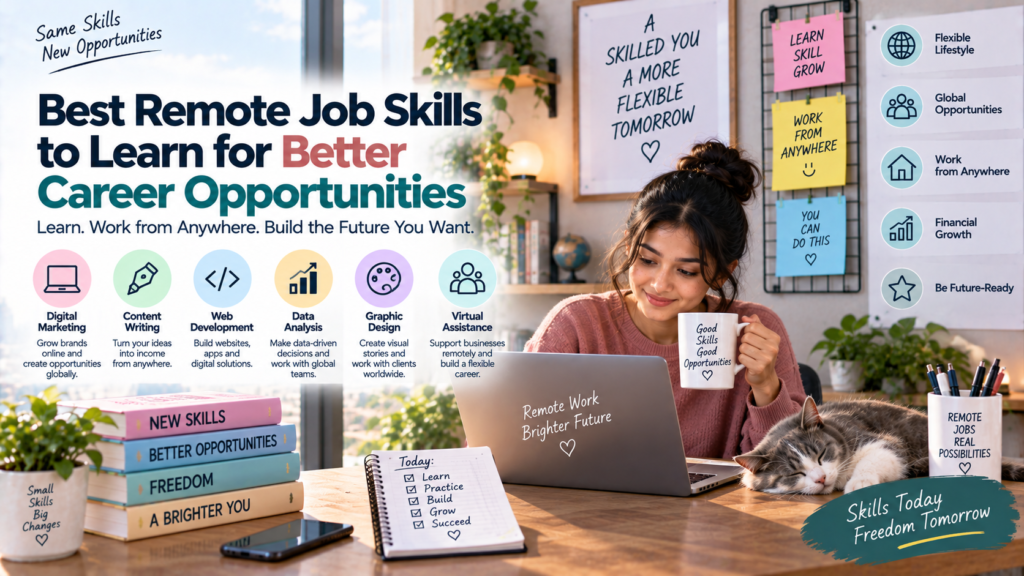

Discover the best remote job skills to learn for better career opportunities. Explore technical, communication, digital, and problem-solving skills for remote work.
Remote work has created new career opportunities across technology, marketing, customer service, finance, education, design, administration, healthcare, and many other fields. As more organisations use digital tools and distributed teams, employers increasingly look for people who can work effectively without being in a traditional office.
Learning the right remote job skills can help job seekers become more competitive. However, remote work is not based on one specific skill. Successful remote professionals often combine job-specific knowledge with communication, organisation, digital literacy, problem-solving, and time-management abilities.
The good news is that many of these skills can be developed through online courses, practical projects, internships, freelance assignments, personal projects, and regular practice. The key is to focus on skills that match your target career rather than trying to learn everything at once.
Why Remote Job Skills Matter
Remote employees often have greater responsibility for organising their own work. They may need to manage deadlines, communicate through digital platforms, solve routine problems independently, and collaborate with colleagues who are working from different locations.
This makes both technical and soft skills valuable. A person may have strong professional knowledge but still struggle in a remote environment if they cannot communicate clearly or manage their workload.
Building a balanced skill set can therefore improve your ability to apply for remote positions and perform effectively after being hired.
Digital Literacy
Digital literacy is one of the most useful foundations for remote work. Employees need to understand how to use computers, online platforms, cloud-based services, communication applications, and digital documents.
Basic digital skills can include managing files, using online calendars, working with documents and spreadsheets, participating in video meetings, and understanding common workplace software.
For beginners, improving digital literacy can make it easier to learn more advanced tools later. It also helps employees adapt when organisations introduce new software.
Communication Skills
Clear communication is essential when colleagues cannot simply walk over to your desk and ask a question.
Remote workers often communicate through email, chat platforms, video meetings, project-management systems, and shared documents. This means your ability to explain information clearly and professionally can directly affect teamwork.
Good remote communication includes writing concise messages, asking useful questions, providing updates, listening during meetings, and explaining problems before they become larger issues.
Written communication is particularly important because many remote teams depend heavily on text-based communication.
Time Management
Remote employees often have more control over their daily schedules, but this flexibility also requires discipline.
Time-management skills help workers organise priorities, estimate how long tasks may take, and complete assignments before deadlines. A simple daily or weekly task list can help create structure.
You can practise this skill by dividing larger projects into smaller tasks and setting realistic deadlines. Over time, this can improve both productivity and reliability.
Self-Discipline
Working remotely can involve distractions that are less common in traditional workplaces. Employees may need to manage household responsibilities, notifications, social media, and other interruptions while completing professional tasks.
Self-discipline helps remote workers stay focused without constant supervision. It involves creating routines, following schedules, taking appropriate breaks, and completing responsibilities consistently.
Employers value workers who can be trusted to manage their responsibilities independently.
Project Management
Project-management skills are useful even if you are not applying for a formal project manager position.
Many remote jobs involve multiple tasks, deadlines, people, and deliverables. Understanding concepts such as task planning, prioritisation, progress tracking, and deadline management can help you contribute more effectively.
You can practise project management by using digital task-management tools for personal or academic projects. Creating a small project plan can also give you something practical to discuss during interviews.
Collaboration Skills
Remote work does not mean working alone all the time. Most remote employees still collaborate with managers, clients, colleagues, vendors, or other teams.
Effective collaboration requires people to share information, respect different working styles, respond to requests, and contribute to shared goals.
Learning how to work with shared documents, project-management systems, communication platforms, and virtual meeting tools can strengthen your remote collaboration abilities.
Problem-Solving Skills
Employers value people who can identify problems and think about possible solutions.
Remote workers may encounter technical issues, unclear instructions, scheduling conflicts, customer concerns, or project delays without having an experienced colleague physically nearby.
Strong problem-solving involves understanding the situation, identifying the main issue, considering possible solutions, and knowing when to ask for help.
You can develop this skill through practical projects, case studies, technical exercises, and real-world work experience.
Adaptability
Technology and workplace processes change quickly. Remote employees may need to learn new software, adjust to new communication systems, or adapt when company priorities change.
Adaptability means being willing to learn and adjust rather than becoming dependent on one particular tool or process.
Instead of focusing only on a single software application, try to understand the broader skill behind it. For example, learning the principles of project management can make it easier to adapt to different project-management platforms.
Microsoft Office and Productivity Tools
Office productivity software remains useful across many remote roles.
Depending on the position, employees may need to work with word processors, spreadsheets, presentations, email, calendars, and shared documents. Spreadsheet skills can be particularly valuable for administration, finance, operations, sales, and data-related work.
Beginners should focus on practical abilities such as formatting documents, organising information, creating basic formulas, preparing presentations, and managing shared files.
More advanced spreadsheet skills can be developed later based on your chosen career path.
Data Analysis Skills
Data is used by businesses in many different departments. Basic data-analysis skills can therefore open opportunities beyond traditional data-focused roles.
Beginners can start by learning spreadsheets, data cleaning, basic charts, simple calculations, and ways to interpret information.
People interested in more technical careers can progress to SQL, Python, statistics, business intelligence tools, or other analytical technologies.
The most useful combination depends on the type of remote position you want to pursue.
Artificial Intelligence Literacy
Artificial intelligence is increasingly becoming part of many professional workflows. Understanding how AI tools can support research, writing, analysis, coding, customer service, and other tasks can be useful across different careers.
AI literacy does not necessarily mean becoming an AI engineer. For many professionals, it means understanding how to use AI tools responsibly, evaluate their output, protect confidential information, and verify important information.
Workers should also understand that AI-generated content may contain errors. Human judgement remains important when using AI for professional tasks.
Cybersecurity Awareness
Remote employees often access company systems from homes, shared spaces, and different networks. Basic cybersecurity knowledge can therefore be valuable.
Important skills include recognising suspicious messages, using strong passwords, understanding multi-factor authentication, keeping software updated, and protecting company information.
Employees should also understand basic data privacy principles and avoid sharing confidential information through unauthorised platforms.
Cybersecurity knowledge is particularly valuable for people interested in IT, technology, finance, healthcare, administration, and other fields that handle sensitive information.
Cloud Computing Basics
Cloud-based platforms allow employees to access applications, files, and services through the internet. Many remote organisations depend on cloud technology for everyday operations.
Understanding basic cloud concepts can be useful even for non-technical employees. Technical professionals can go further by learning cloud platforms, infrastructure, databases, security, and deployment concepts.
For beginners, start with the basic idea of cloud storage, cloud applications, access management, and online collaboration before moving into advanced cloud technologies.
Web Development
Web development remains a valuable skill for people interested in technology careers.
Beginners can start with HTML and CSS before learning JavaScript. After building a strong foundation, they can explore frontend frameworks, backend development, databases, APIs, and version-control systems.
A portfolio can be especially useful in this field. Creating websites or small applications allows candidates to demonstrate practical abilities rather than relying only on certificates.
Digital Marketing
Digital marketing offers remote opportunities across many industries.
Useful skills include search engine optimisation, content marketing, social media management, email marketing, analytics, paid advertising, and basic marketing strategy.
Beginners should avoid trying to master every area immediately. Choosing one or two specialisations and creating practical examples can provide a stronger foundation.
Content Writing and Editing
Writing skills are useful in marketing, education, media, technology, customer support, and many other industries.
Remote writers may create blog posts, website content, product descriptions, newsletters, social media content, technical documentation, or business communications.
Editing and proofreading skills can further improve career opportunities. A strong portfolio with several relevant writing samples can help demonstrate ability to potential employers.
Customer Service Skills
Remote customer-service positions are common across industries. Employees may communicate with customers through chat, email, phone calls, or support platforms.
Important skills include active listening, empathy, clear communication, patience, problem-solving, and product knowledge.
Learning customer relationship management software and ticketing systems can also make candidates more prepared for remote support roles.
Sales and Negotiation
Sales skills can be useful for remote positions in business development, account management, recruiting, real estate, technology, and other industries.
Important abilities include understanding customer needs, presenting solutions, handling objections, following up, and maintaining professional relationships.
Negotiation skills can also help professionals communicate value and reach agreements with clients or business partners.
Cybersecurity and IT Support
People interested in technical remote careers can explore IT support and cybersecurity.
IT support professionals help users troubleshoot hardware, software, network, and account-related issues. Cybersecurity professionals focus on protecting systems, networks, applications, and data.
These careers generally require more specialised training, but beginners can start with computer fundamentals, networking concepts, operating systems, and security basics.
How to Choose the Right Remote Job Skills
The best skills to learn depend on your career goal.
If you want to become a web developer, focus on programming, databases, version control, and web technologies. If you want a remote marketing role, concentrate on SEO, content, analytics, social media, and digital marketing tools.
For administrative positions, prioritise communication, spreadsheets, scheduling, organisation, documentation, and productivity software.
Choosing skills based on a specific target role prevents you from spending months learning unrelated technologies.
Build Skills Through Practical Projects
Learning becomes more valuable when you can demonstrate what you know.
Instead of completing course after course without practical experience, create small projects related to your target career. A marketing student might create a sample campaign, while an aspiring developer could build a simple website.
These projects can become portfolio pieces. They can also give you examples to discuss during interviews.
Create a Remote-Friendly Portfolio
A portfolio can help employers understand your abilities quickly.
Depending on your career, your portfolio could include websites, writing samples, design projects, data-analysis work, marketing campaigns, presentations, software projects, or other relevant examples.
Keep the portfolio organised and focused on the type of position you want. Quality is generally more valuable than filling it with unrelated projects.
Develop a Learning Plan
Trying to learn too many skills simultaneously can become overwhelming.
Start with one core career skill and two or three supporting skills. For example, an aspiring data analyst might focus on spreadsheets, SQL, and data visualisation before moving to more advanced technologies.
Set weekly learning goals and spend time practising what you learn. Consistency is often more useful than studying intensively for a short period and then stopping.
Keep Improving After Getting a Job
Skill development should not stop after you find employment.
Remote professionals may need to learn new software, adapt to changing business requirements, or develop leadership and communication abilities as their careers progress.
Regular learning can help professionals remain competitive and prepare for opportunities such as promotions, specialised positions, freelance work, or career changes.
Sources
- https://www.weforum.org/publications/the-future-of-jobs-report-2025/
- https://www.oecd.org/en/topics/skills.html
- https://www.ilo.org/topics/skills-and-lifelong-learning
- https://www.naceweb.org/career-readiness/competencies/career-readiness-defined/
- https://www.bls.gov/ooh/
Conclusion
The best remote job skills combine technical knowledge with strong professional habits. Digital literacy, communication, time management, problem-solving, adaptability, collaboration, and self-discipline can support almost any remote career, while specialised skills such as web development, data analysis, digital marketing, cybersecurity, writing, and IT support can help candidates target specific roles.
Rather than trying to learn everything at once, choose a career direction and build skills around it. With practical projects, continuous learning, and a focused portfolio, job seekers can improve their readiness for remote opportunities and build stronger long-term career prospects.
FAQs
1. What are the best skills for remote jobs?
Communication, digital literacy, time management, collaboration, problem-solving, adaptability, and self-discipline are useful across many remote positions. Specialised technical or professional skills can further improve opportunities.
2. Which remote skills are best for beginners?
Beginners can start with digital literacy, communication, Microsoft Office or similar productivity tools, basic data skills, customer service, writing, or entry-level digital marketing.
3. Is coding necessary for remote work?
No. Coding is valuable for technology careers, but many remote jobs do not require programming. Remote opportunities also exist in marketing, writing, customer support, administration, education, sales, design, and other areas.
4. How can I learn remote job skills?
You can learn through online courses, tutorials, books, practical projects, internships, certifications, and regular practice. Combining learning with real projects can help demonstrate your abilities.
5. Are soft skills important for remote jobs?
Yes. Communication, organisation, teamwork, adaptability, and problem-solving are particularly important because remote employees rely heavily on digital communication and independent work.
6. What technical skills can help with remote jobs?
Depending on your career, useful technical skills may include web development, data analysis, SQL, cloud computing, cybersecurity, digital analytics, software development, or productivity software.
7. Should I learn AI skills for remote work?
AI literacy can be useful in many careers. Learning how to use AI tools responsibly, evaluate their results, and protect confidential information can complement your existing professional skills.
8. How long does it take to learn remote job skills?
The time varies depending on the skill and your starting level. Basic skills can be developed relatively quickly, while advanced technical skills may require months or longer of consistent study and practice.
9. Can a portfolio help me get a remote job?
Yes. A relevant portfolio can demonstrate practical ability and give employers examples of your work. It can be especially useful for developers, writers, designers, marketers, and other project-based professionals.
10. What is the best way to choose a remote career skill?
Start by choosing a target job or career area. Review the skills commonly required for that position and build your learning plan around the most important technical and professional skills.