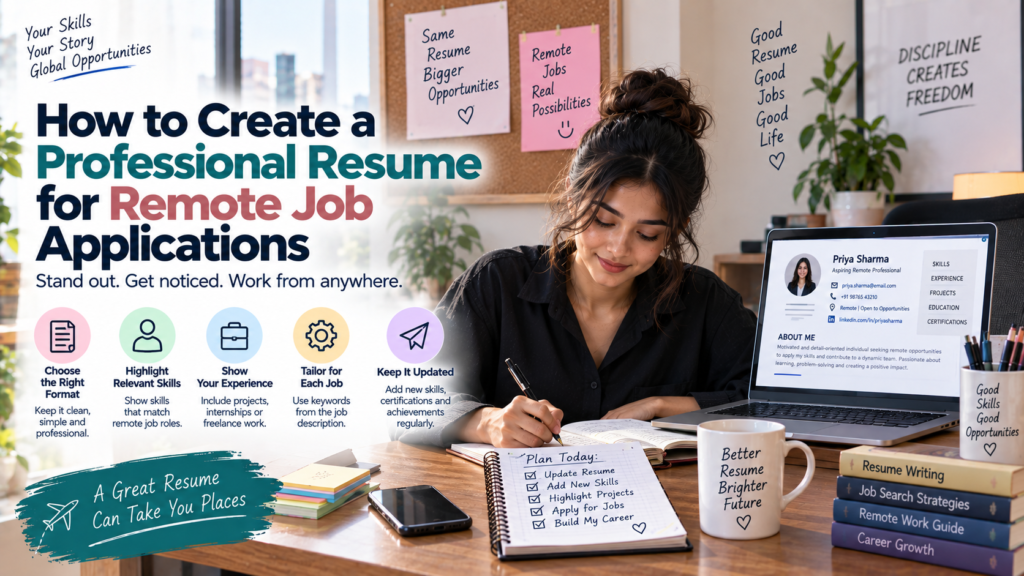

Learn how to create a professional resume for remote job applications. Discover resume structure, remote work skills, formatting tips, keywords, and common mistakes.
A professional resume is one of the most important tools when applying for remote jobs. Since employers may receive applications from candidates in different locations, your resume needs to communicate your skills, experience, and suitability for remote work clearly and quickly.
A strong remote job resume should do more than list previous positions. It should demonstrate that you can communicate effectively, manage deadlines, use digital tools, work independently, and collaborate with colleagues through online platforms.
Whether you are an experienced professional, recent graduate, student, or beginner, you can create a resume that highlights your strengths. The key is to keep the document focused on the position you want and provide evidence of relevant skills.
Understand the Job Before Writing Your Resume
Before creating or updating your resume, carefully read the job description.
Identify the qualifications, technical skills, responsibilities, software, and professional qualities mentioned by the employer. These details can help you determine which parts of your background deserve the most attention.
For example, a remote customer-service position may emphasise communication, customer support software, problem-solving, and time management. A remote developer position may focus more on programming languages, frameworks, databases, APIs, and version-control systems.
Your resume should reflect the requirements of the specific position rather than using exactly the same version for every application.
Use a Clear Resume Structure
A professional resume should be easy to scan.
A simple structure can include:
- Name and contact information
- Professional summary
- Skills
- Work experience
- Education
- Projects
- Certifications
- Additional relevant information
Not every section is necessary for every candidate. Students and beginners may give more space to education, projects, internships, and skills, while experienced professionals may focus more heavily on employment history and achievements.
Add Accurate Contact Information
Your contact information should be easy to find at the top of the resume.
Include your full name, professional email address, phone number, and relevant professional profile or portfolio if you have one.
You generally do not need to include unnecessary personal information. Keep the contact section professional and focused on information an employer can use to reach you.
Use an email address that looks professional rather than an informal nickname or outdated address.
Write a Strong Professional Summary
The professional summary gives the employer a quick overview of your background.
Keep it concise and relevant to the position. Mention your professional area, strongest skills, relevant experience, and the type of value you can bring to a remote team.
For example, instead of writing a generic statement such as “Hardworking person looking for a job,” focus on specific abilities and career direction.
A stronger summary explains what you can do and why your background is relevant.
Highlight Remote Work Skills
Remote employers often look for skills that support independent and digital work.
Depending on the position, useful skills may include:
- Written and verbal communication
- Time management
- Organisation
- Self-discipline
- Problem-solving
- Online collaboration
- Digital literacy
- Adaptability
- Project management
- Customer service
Do not simply add these skills because they sound good. Include skills you can demonstrate through your work, projects, education, volunteering, or other experience.
Include Relevant Technical Skills
Technical skills should match the position you are applying for.
For a web development role, relevant skills might include HTML, CSS, JavaScript, Python, databases, APIs, or version-control systems.
For digital marketing, skills might include SEO, content management, analytics, social media, email marketing, or advertising platforms.
For administrative roles, spreadsheet software, document management, scheduling tools, and communication platforms may be more relevant.
Avoid filling the resume with technologies you have only briefly explored. Employers may ask about any skill you list.
Describe Work Experience With Results
One of the most important parts of a resume is the work experience section.
Instead of simply listing duties, explain what you accomplished.
For example, rather than writing that you “handled customer emails,” you could describe how you responded to customer enquiries, resolved routine issues, maintained records, or supported service improvements.
Whenever possible, include measurable results. Numbers can make achievements easier to understand when they are accurate and relevant.
Show Experience With Remote Collaboration
If you have previous remote experience, make it visible.
Mention relevant activities such as working with distributed teams, attending virtual meetings, managing online projects, communicating through collaboration platforms, or completing assignments independently.
If you have never had a remote job, do not claim that you have.
Instead, demonstrate transferable experience. College projects, internships, freelance assignments, volunteer activities, and group projects can show that you know how to communicate and complete tasks using digital tools.
Include Projects
Projects can be especially valuable for students, recent graduates, career changers, and beginners.
A project can demonstrate practical skills even when you have limited professional experience.
For each relevant project, briefly explain:
- What you created or completed
- Your specific responsibilities
- Tools or technologies used
- The problem you addressed
- The result or outcome
For example, an aspiring developer could include a website or application they created. A marketing candidate could include a sample campaign or content strategy.
Choose projects that support the type of remote job you want.
Include Freelance and Volunteer Experience
Freelance work and volunteering can provide valuable evidence of professional skills.
If you completed freelance writing, design, web development, tutoring, administrative support, or other relevant work, consider including it.
Volunteer experience can also demonstrate communication, organisation, teamwork, leadership, and responsibility.
Treat relevant freelance and volunteer work seriously. Describe your responsibilities and contributions just as you would for other relevant experience.
Highlight Education Appropriately
Education is particularly important for students and recent graduates.
Include your degree or qualification, institution, field of study, and relevant dates where appropriate.
You can also mention relevant coursework, academic projects, achievements, or certifications when they directly support the job application.
Experienced professionals may keep the education section shorter if their work history provides stronger evidence of their qualifications.
Add Relevant Certifications
Certifications can demonstrate structured learning and interest in a particular career area.
Examples may include certifications related to technology, project management, digital marketing, data analysis, cybersecurity, language skills, or other professional fields.
Only include certifications that are genuine and relevant.
Avoid adding a long list of unrelated certificates simply to make the resume look more impressive. A small number of relevant credentials can be more useful.
Use Keywords Naturally
Many employers use applicant tracking systems to help organise and screen resumes.
Using relevant terms from the job description can make it easier for your application to match the position.
For example, if the job description repeatedly refers to “customer relationship management,” “remote collaboration,” or “data analysis,” use accurate versions of those terms when they genuinely describe your experience.
Do not copy the entire job description into your resume or repeat keywords unnaturally. The content should remain readable and truthful.
Keep the Resume Easy to Read
Good formatting helps employers find information quickly.
Use clear section headings, consistent spacing, readable fonts, and a logical structure. Keep formatting consistent throughout the document.
Avoid excessive graphics, complicated layouts, decorative elements, or large blocks of text that make the resume difficult to scan.
A professional resume should look organised rather than crowded.
Keep the Length Appropriate
There is no universal rule that every resume must fit on exactly one page.
For students and candidates with limited experience, a focused one-page resume may be sufficient. Professionals with several years of relevant experience may need additional space.
The important principle is relevance. Remove information that does not help demonstrate your suitability for the position.
Mention Your Location Clearly
Remote does not always mean that a job can be performed from anywhere.
Some employers may hire only within a particular country, state, province, or time zone because of employment regulations, working hours, or business requirements.
Include your location accurately when appropriate and pay attention to the geographic requirements in the job advertisement.
Do not claim that you are available in a location where you are not legally or practically able to work.
Mention Time Zone Availability When Relevant
Time-zone flexibility can matter for remote positions.
If a job requires employees to work particular hours or overlap with another region, your availability may be important.
You can mention your time zone or relevant availability when it supports the application. However, avoid adding unnecessary scheduling details unless they are relevant to the role.
Create a Professional Portfolio
A resume tells employers about your skills, while a portfolio can show those skills in practice.
A portfolio can include websites, applications, writing samples, designs, marketing campaigns, presentations, data projects, research work, or other relevant examples.
Keep the portfolio organised and make sure every project is your own work or clearly identifies collaborative contributions.
For remote roles where practical output matters, a strong portfolio can complement your resume significantly.
Tailor Your Resume for Each Application
One of the most effective ways to improve a resume is to customise it.
You do not need to rewrite the entire document for every job. Instead, adjust the professional summary, skills, experience descriptions, and project selection based on the position.
Place the most relevant information where the employer can easily see it.
A tailored resume demonstrates that you understand the role rather than submitting the same generic application everywhere.
Use Strong Action Words
Action-oriented language can make experience descriptions more effective.
Words such as “developed,” “managed,” “created,” “analysed,” “coordinated,” “supported,” “improved,” “organised,” and “implemented” can clearly communicate your contribution when used accurately.
Avoid repeating the same phrase in every bullet point.
Focus each statement on what you did and, when possible, the result.
Avoid Common Resume Mistakes
Even a strong background can be weakened by avoidable resume problems.
Common mistakes include:
- Spelling and grammar errors
- Outdated contact information
- Unprofessional email addresses
- Excessive personal information
- Long paragraphs
- Unrelated skills
- False claims
- Generic summaries
- Inconsistent formatting
- Poorly organised sections
- Listing every job without considering relevance
Proofread your resume carefully before submitting it.
Do Not Exaggerate Your Skills
Honesty is essential when creating a professional resume.
Do not claim expertise in software, programming languages, foreign languages, or professional responsibilities that you cannot explain during an interview.
Employers may test your knowledge or ask you to provide examples.
It is better to list a smaller number of genuine skills and demonstrate them well than to create an impressive-looking list that you cannot support.
Prepare Your Resume for Remote Interviews
Your resume should provide useful material for interview discussions.
Review every major claim before an interview. Be prepared to explain your projects, responsibilities, achievements, technical skills, and examples of working independently.
If you mention a specific remote collaboration tool, think about how you used it. If you list a project, understand the decisions you made and challenges you encountered.
This preparation can help you answer interview questions with greater confidence.
Keep Your Resume Updated
A resume should evolve as your career develops.
Whenever you complete a new project, certification, internship, freelance assignment, or relevant course, consider whether it should be added.
Remove outdated or irrelevant information when necessary.
Keeping a current resume also means you can apply to suitable opportunities without having to rebuild the document from the beginning.
Resume Checklist for Remote Job Applications
Before submitting your application, check the following:
- Is the resume tailored to the job?
- Is your contact information accurate?
- Does the professional summary match your career direction?
- Are relevant remote-work skills clearly shown?
- Are technical skills truthful and current?
- Are achievements described clearly?
- Have you included relevant projects?
- Is the formatting consistent?
- Are there spelling or grammar mistakes?
- Have you included relevant portfolio information?
- Does the resume contain keywords from the job description naturally?
- Can you explain everything listed during an interview?
A final review can prevent simple mistakes from weakening an otherwise strong application.
Sources
- https://www.careeronestop.org/
- https://www.bls.gov/ooh/
- https://www.naceweb.org/career-readiness/competencies/career-readiness-defined/
- https://www.indeed.com/career-advice/resumes-cover-letters
- https://www.dol.gov/general/topic/training
Conclusion
Creating a professional resume for remote job applications requires a clear understanding of both the position and the skills needed to succeed remotely. Your resume should highlight relevant experience, technical abilities, communication skills, independence, organisation, and evidence that you can work effectively in a digital environment.
Students and beginners can use projects, internships, volunteer activities, freelance work, and academic experience to demonstrate their abilities. Experienced professionals can focus on measurable achievements and relevant remote collaboration experience.
Most importantly, keep your resume accurate, focused, easy to read, and tailored to each opportunity. A well-prepared resume can help employers quickly understand what you can contribute to a remote team.
FAQs
1. What should a remote job resume include?
A remote job resume can include contact information, a professional summary, relevant skills, work experience, education, projects, certifications, and portfolio information where appropriate.
2. Should I mention remote work skills on my resume?
Yes. Skills such as communication, time management, organisation, independent work, digital collaboration, and adaptability can be relevant to remote positions when you can demonstrate them.
3. How can beginners create a resume without work experience?
Beginners can highlight education, academic projects, internships, volunteer work, freelance assignments, certifications, personal projects, and transferable skills.
4. Should I include my location on a remote resume?
In many cases, yes. Remote positions may have geographic or employment restrictions, so accurate location information can help employers determine whether you meet the role’s requirements.
5. How long should a remote job resume be?
The appropriate length depends on your experience. A focused one-page resume may work well for beginners, while experienced professionals may need more space for relevant achievements.
6. Are keywords important for remote job resumes?
They can be important because some employers use applicant tracking systems to organise applications. Use relevant keywords from the job description naturally and only when they accurately describe your skills.
7. Should students include college projects on their resumes?
Yes. Relevant academic projects can demonstrate technical knowledge, research, teamwork, problem-solving, and other abilities when professional experience is limited.
8. Should I create a portfolio for remote jobs?
A portfolio can be very helpful for roles involving practical work, including software development, writing, design, marketing, data analysis, and content creation.
9. What are common remote resume mistakes?
Common mistakes include using a generic resume, listing unrelated skills, making false claims, using poor formatting, including errors, and failing to demonstrate skills relevant to remote work.
10. Should I use the same resume for every remote job?
It is better to tailor your resume for each relevant application. Adjust your summary, skills, experience, and projects to emphasise the qualifications most relevant to the specific position.